|
bed
cycle
cyclic
events
Milankovitch cycles
parasequence
sequence
stacking patterns
|
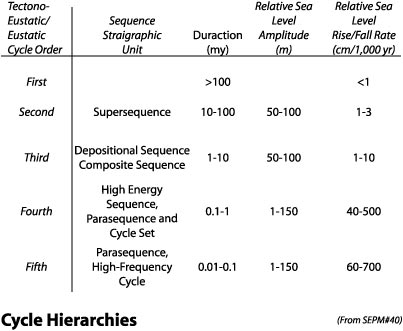
Sedimentary rocks are more often formed by rhythms and cyclic alternations of strata. These have been divided into varve scale laminations, bed scale rhythms and cycles (Einsele et al, 1991; and Schwarzacher, 2000),. The attached diagrams list some of their different orders and character. For instance Vail et al, (1977), and Haq et al (1987) subdivide depositional sequences and cycles largely on the basis of time into first to sixth order. Their smallest unit is the parasequence of van Wagoner et al (1988). The parasequence can been equated with the cyclothem used to describe the Pennsylvanian coal-bearing deltaic sequences of the Appalachians (Weller, 1964), the shallow water and peritidal carbonate cycle observed in the Mesozoic of the Apennines (elementary cycles of D'Argenio et al, 1999) and Southern Alps (Lofer cyclothems of Fischer, 1964; and depositional cycles of Goldhammer et, 1990), and the "simple" carbonate sequence cycles (for the platform carbonate cycles of the Upper Miocene of Mallorca (Pomar, personal communication).
- Strictly cyclic and periodic sequences formed over a regular time period are distinct from dicyclic or non-periodic sequences caused by irregular stratigraphic events or by recurrent processes associated with the depositional regime (autocyclic processes) (Einsele et al , 1991).
- Sedimentary cycles may coarsen or fine upward, form symmetric or asymmetric sequences, as well as form complete and incomplete cycles, the latter reflecting non-deposition or erosion during the depositional cycle.
- Recurring processes generate successions of bundles cyclic beds.
- Recurring cycles, particularly those with recurring or evolving faunas are used for stratigraphic correlation and mapping.
For more data on cycles and events in stratigraphy, the compilations of Einsele et al (1991) and (Schwarzacher, 2000) represent useful sources. Einsele et al (1991) has assembled numerous review articles on cycles in the stratigraphic record and both have extensive lists of references.
References Cited
D'Argenio, Bruno, Vittoria Ferreri, Arturo Raspini, Sabrina Amodio, and Francesco P. Buonocunto, (1999), Cyclostratigraphy of a carbonate platform as a tool for high-precision correlation, Tectonophysics 315 357–384.
Einsele G., Ricken W., and Seilacher A., (editors), 1991, "cycles and events in stratigraphy", Springer-Verlag, Berlin, Heidelberg, New York 1991. 955p.
Fischer, A. G., 1964, The Lofer cyclothems of the Alpine Triassic: Kansas Geological Survey Bulletin, v. 169, p. 107–149.
Goldhammer, R. K., Dunn, P. A., and Hardie, L. A., 1990, Depositional cycles, composite sea-level changes, cycle stacking patterns, and the hierarchy of stratigraphic forcing: Examples from Alpine Triassic platform carbonates: Geological Society of America Bulletin, v. 102, p. 535–562.
Haq, B.U., Hardenbol, J., Vail, P.R., 1987. Chronology of fluctuating sea levels since the Triassic. Science 235, 1156–1166.
Schwarzacher, W., (2000), Repetitions and cycles in stratigraphy. Earth-Science Reviews, 50: 51-75.
Vail, P.R., Mitchum Jr., R.M., Thompson III, S., 1977. Seismic stratigraphy and global changes of sea level. Part 3: relative changes of sea level from coastal onlap. in: Payton, C.E. (Ed.), Seismic stratigraphy––Applications to Hydrocarbon Exploration, vol. 26. American Association of Petroleum Geologists Memoir, pp. 63–81.
Van Wagoner, J.C., Posamentier, H.W., Mitchum, R.M., Vail, P.R., Sarg, J.F., Loutit, T.S., Hardenbol, J., 1988. An overview of sequence stratigraphy and key definitions. In: Wilgus, C.K., Hastings, B.S., Kendall, C.G.St.C., Posamentier, H.W., Ross, C.A., Van Wagoner, J.C. (Eds.), Sea Level Changes––An Integrated Approach, vol. 42. SEPM Special Publication, pp. 39–45.
Weller, J. Marvin, 1964, Development of the Concept and Interpretation of rythmic Sedimentation; in D.F. Merriam, ed., Symposium on rythmic sedimentation: Kansas Geological Survey, Bulletin 169, pp. 607-621



|