igneous rocks
metamorphic
rocks
sedimentary rocks
|
Most dolomites are diagenetic replacements of limestone. Sedimentary dolomite may have been more important in the past but the best known Holocene examples come from the evaporative coastal lagoons of the Coorong, of South Australia. Currently sedimentary dolomite is thought to have been rare in the sedimentary record and most is thought to be a product of diagenesis. For a more complete description go to the section on dolomite.
Dolmite /dolostone = CaMg(CO3) 2. Rock probably began as a calcitic rock (CaCO3) (an algal laminated micrite), but was converted to dolomite after formation.
Description
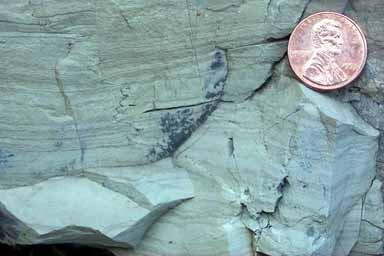
Dense, uniform, fine grained rock with conchoidal fracture. Faint, weak laminations running parallel to bedding. The laminations are probably algal laminates, produced on tidal flats by colonies of blue-green algae.
Tectonic Association
Carbonates of all types are commonly associated with regions of tectonic stability and tropical climates, that is no mountain building, and stable, shallow water environments associated with continental shelves or epeiric (epicontinental) seas.
Formation & Environments
There is a lot of controversy about the origin of dolomite. Most of it is probably of secondary origin from the recrystallization of limestone by the substitution of magnesium atoms for calcium atoms in the crystal structure. This rock is likely a recrystallized algal laminated micrite. See Origin Of dolomite for more Data.
One way or another, dolomitic rocks are formed in many of the environments limestones form in - just depending on the limestone. This particular exposure is algal laminated, and found with other evidence of tidal flat feature. It most likely formed in the Upper Intertidal To Supertidal Region.
Detail
Composition
Dolomite/dolostone = CaMg(CO3) 2. Rock probably began as a calcitic rock (CaCO 3) (an Algal laminated micrite), but was converted to dolomite after form .
Description
In this detail we can more easily see the algal laminates (faint horizontal laminations running from left to right). Also notice the gray, almost chalky appearance; this is typical of dolomite. With experience dolomite can be recognized on site with out the need for testing with HCL acid. This rock, by the way, reacts very weakly with acid, producing very fine bubbles, slowly.
|